by Sverre Raffnsøe, Marius Gudmand-Høyer, Morten S. Thaning
Abstract: This article advances the ‘dispositive’ (le dispositif) as a key conception in Foucault’s work. As developed in his annual lectures in 1978 and 1979, the dispositive represents a crucial constituent of societal analysis on par with the familiar analytics of power/knowledge and the governmentality perspective – indeed it forms a lesser known intermediary between these. Foucault’s dispositional analysis articulates a history of connected social technologies that we have constructed to relate to each other. Expounding these points, the article distinguishes various dispositional prototypes and develops key ‘socio-ontological’ implications of the analysis. Reinstating the proper analytical status of the dispositive contributes to the reception of the important notion; the interpretation of Foucault’s entire oeuvre; and a resourceful approach to the study of contemporary societal problems.
Note: The present working paper represents an earlier version of our article “Foucault’s dispositive: The perspicacity of dispositive analytics in organizational research”, reviewed and published
by Organization (Sept. 17, 2014; DOI: 10.1177/1350508414549885). We have chosen to distribute it since this paper, compared to the later, thoroughly revised article, presents more details pertaining to Foucault’s use of the dispositive as an analytical concept, as well as a number of the more general implications of this type of historico-philosophical social analytics.
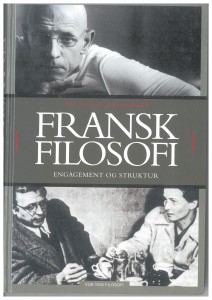 Uddrag fra bogen:
Politikens Håndbøger: Fransk Filosofi, Engagement og Struktur, redigeret af Poul Lübcke, (Denmark, Politikens Forlag A/S, 2004), pp. 286-298.
]]>Uddrag fra bogen:
Politikens Håndbøger: Fransk Filosofi, Engagement og Struktur, redigeret af Poul Lübcke, (Denmark, Politikens Forlag A/S, 2004), pp. 267-285.
]]>Uddrag fra bogen:
Politikens Håndbøger: Fransk Filosofi, Engagement og Struktur, redigeret af Poul Lübcke, (Denmark, Politikens Forlag A/S, 2004), pp. 248-267.
]]>
Uddrag fra bogen:
Politikens Håndbøger: Fransk Filosofi, Engagement og Struktur, redigeret af Poul Lübcke, (Denmark, Politikens Forlag A/S, 2004), pp. 222-248.
]]>
Postmodernismen tager sit udgangspunkt i Lyotards bog fra 1979 om den “postmoderne” tilstand, idet udtrykket “det moderne” henviser til den måde at tænke på, som kendetegner tiden efter oplysningstiden. Inden for det moderne har der været en tendens til at erstatte religionens og den klassiske metafysiks “store fortællinger” med videnskabelige eller ideologiske sekulariserede fortællinger, herunder den store fortælling om oplysningen som en historisk bevægelse mod sandhed og frigørelse. Alle disse fortællinger er i dag døde, og postmodernisterne griber derfor tilbage til en anden tendens inden for modernismen (og traditionen i øvrigt), nemlig tendensen til at fokusere på det individuelle, det opsplittede og det foreløbige. Samtidig stilles der spørgsmål ved, om vore symboler – eller i det mindste det videnskabelige sprog – er i stand til at gengive virkeligheden. Dette benyttes til en analyse og kritik af videnssamfundet (Lyotard), forbrugersamfundet (Baudrillard) og etikken (Lipovetsky).
Kapitel fra Politikens Håndbøger: Fransk Filosofi, Engagement og Struktur, redigeret af Poul Lübcke, (Denmark, Politikens Forlag A/S, 2004) 286-298.
Indhold:
Lyotard: Det Postmoderne
Poststrukturalismen er en samlebetegnelse for tankegangen hos en ny generation af filosoffer bestående af Foucault, Derrida og Deleuze, der i anden halvdel af 1960’erne viderefører det strukturalistiske opgør med den humanistiske tradition, samtidig med at de kritiserer strukturalismens idé om at kunne erkende almengyldige, ahistoriske strukturer.I stedet betones erkendelsens kontekstafhængighed og det singulære. Begreber som “begivenhed” og “forskel” kommer derved til at få en central betydning. Samtidig indleder der med udgangspunkt i Nietzsche og den sene Heidegger et gennemgribende opgør med den metafysiske tradition fra Plation og frem til det 20. århundrede.
Endelig kommer kunsten til at få en central betydning i forhold til filosofien, idet poststrykturalisterne kritiserer begrebet om det afsluttede filosofiske eller kunstneriske værk. I stedet betones de litterære frembringelsers fragmentariske og foreløbige karakter. Samtidig udviskes grænserne mellem de forskellige genrer, såsom filosofi, litteratur og videnskab.
Kapitel om Foucault, Derrida og Deleuze fra Politikens Håndbøger: Fransk Filosofi, Engagement og Struktur, redigeret af Poul Lübcke, (Denmark, Politikens Forlag A/S, 2004) 217-285.
Indhold:
Poststrukturalismen: Kontekst, Forskel og Singularitet
Foucault: Filosofiens historicitet
Derrida: Idealitetens transcendentale historicitet
Deleuze: Filosofiens immanente flugtveje
Download PDF ved at trykke på billedet
]]>
 I never became interested in philosophy primordially or originally. There is no source event or transformation that I can recall as being the defining moment. Stating ‘It began here!’ would be misleading… I am not even certain that I originally attained an interest, or even that I still am interested in philosophy as a privileged object of investigation and investment ‐ an aim in itself. There are, however, moments and situations in my life where an interest in philosophy has appeared or is necessarily forced upon me; these are times when philosophy appears as a seemingly unavoidable and essential questioning of fundamentals,– as a ‘basic’ need. This being said, it can be annoying as well as cumbersome. Philosophy as a ‘basic’ need makes itself felt as an estrangement that has always already taken place. It takes the form of a “Schritt zurück” in which one pulls away from, problematizes and reconsiders the given, including the given sense of community, its presuppositions and even the given self. As now, where I find myself writing this at a seaside hotel and consider whether I would prefer to stroll to the restaurant and chat with friends rather than continue taking pains to scrutinize and reflect. Incidentally a well‐known ‘philosophical’ ‘solution’ or resort since Hume. Concurrently, however, I sense that this latter choice may be lacking in philosophical substance. In such situations, philosophy becomes equated with a tendency towards seclusion – even with being secluded from myself.
Suggested citation:
Raffnsøe, Sverre: “Philosophy as Estrangement” MPP Working Paper Series: 2/2013. Available via http://openarchive.cbs.dk/handle/10398/8810
Also available via: https://www.academia.edu/5335111/Philosophy_as_Estrangement
]]>
Si l’on peut parler d’homme normal […]
c’est parce qu’il existe des hommes normatifs,
pour qui il est normal de faire craquer les normes
et d’en instituer de nouvelles.
Canguilhem: Le normal et le pathologiquer
Suggested citation:
Raffnsøe, Sverre “Order Ordealed, Norms and Social Coherence in the Age of Law” in Vincent F. Hendricks and Jesper Ryberg (eds.) Readings in Philosophy and Science Studies, Vol. 1. Roskilde: Roskilde University 2002, pp. 120-146.
Also available via: http://cbs.academia.edu/SverreRaffns%C3%B8e
]]>