by Sverre Raffnsøe, Marius Gudmand-Høyer, Morten S. Thaning
Abstract: This article advances the ‘dispositive’ (le dispositif) as a key conception in Foucault’s work. As developed in his annual lectures in 1978 and 1979, the dispositive represents a crucial constituent of societal analysis on par with the familiar analytics of power/knowledge and the governmentality perspective – indeed it forms a lesser known intermediary between these. Foucault’s dispositional analysis articulates a history of connected social technologies that we have constructed to relate to each other. Expounding these points, the article distinguishes various dispositional prototypes and develops key ‘socio-ontological’ implications of the analysis. Reinstating the proper analytical status of the dispositive contributes to the reception of the important notion; the interpretation of Foucault’s entire oeuvre; and a resourceful approach to the study of contemporary societal problems.
Note: The present working paper represents an earlier version of our article “Foucault’s dispositive: The perspicacity of dispositive analytics in organizational research”, reviewed and published
by Organization (Sept. 17, 2014; DOI: 10.1177/1350508414549885). We have chosen to distribute it since this paper, compared to the later, thoroughly revised article, presents more details pertaining to Foucault’s use of the dispositive as an analytical concept, as well as a number of the more general implications of this type of historico-philosophical social analytics.
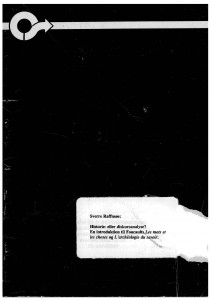 Sverre Raffnsøe (1999) Historie- eller diskursanalyse? En introduktion til Foucaults Les mots et les choses og L’archéologie du savoir, Faggruppen for filosofi/videnskabsteori, Roskilde Univeritetscenter
COS-rapport nr. 4/1999
ISSN 1395-0657
Sverre Raffnsøe – Historie eller Diskursanalyse
Follow me on Academia.edu
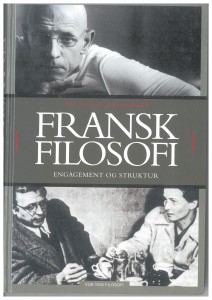 Uddrag fra bogen:
Politikens Håndbøger: Fransk Filosofi, Engagement og Struktur, redigeret af Poul Lübcke, (Denmark, Politikens Forlag A/S, 2004), pp. 286-298.
]]>Uddrag fra bogen:
Politikens Håndbøger: Fransk Filosofi, Engagement og Struktur, redigeret af Poul Lübcke, (Denmark, Politikens Forlag A/S, 2004), pp. 267-285.
]]>Uddrag fra bogen:
Politikens Håndbøger: Fransk Filosofi, Engagement og Struktur, redigeret af Poul Lübcke, (Denmark, Politikens Forlag A/S, 2004), pp. 248-267.
]]>
Uddrag fra bogen:
Politikens Håndbøger: Fransk Filosofi, Engagement og Struktur, redigeret af Poul Lübcke, (Denmark, Politikens Forlag A/S, 2004), pp. 222-248.
]]>
Poststrukturalismen er en samlebetegnelse for tankegangen hos en ny generation af filosoffer bestående af Foucault, Derrida og Deleuze, der i anden halvdel af 1960’erne viderefører det strukturalistiske opgør med den humanistiske tradition, samtidig med at de kritiserer strukturalismens idé om at kunne erkende almengyldige, ahistoriske strukturer.I stedet betones erkendelsens kontekstafhængighed og det singulære. Begreber som “begivenhed” og “forskel” kommer derved til at få en central betydning. Samtidig indleder der med udgangspunkt i Nietzsche og den sene Heidegger et gennemgribende opgør med den metafysiske tradition fra Plation og frem til det 20. århundrede.
Endelig kommer kunsten til at få en central betydning i forhold til filosofien, idet poststrykturalisterne kritiserer begrebet om det afsluttede filosofiske eller kunstneriske værk. I stedet betones de litterære frembringelsers fragmentariske og foreløbige karakter. Samtidig udviskes grænserne mellem de forskellige genrer, såsom filosofi, litteratur og videnskab.
Kapitel om Foucault, Derrida og Deleuze fra Politikens Håndbøger: Fransk Filosofi, Engagement og Struktur, redigeret af Poul Lübcke, (Denmark, Politikens Forlag A/S, 2004) 217-285.
Indhold:
Poststrukturalismen: Kontekst, Forskel og Singularitet
Foucault: Filosofiens historicitet
Derrida: Idealitetens transcendentale historicitet
Deleuze: Filosofiens immanente flugtveje
Download PDF ved at trykke på billedet
]]>
La notion de dispositif est déterminante dans l’analytique foucaldienne de la société. Et pourtant, son étude demeure négligée par la réception internationale. Après avoir discuté brièvement des difficultés rencontrées avec la traduction du terme de dispositif par Dreyfus et Rabinow dans Beyond Structuralism and Hermeneutics, l’article développe une analytique sociale à partir de la pensée « dispositionelle » de Foucault. L’esquisse de l’histoire du terme de dispositif permettra, en outre, de mieux saisir la pertinence de son usage par Foucault.
Download PDF (From Symposium)
Recommended Citation:
Raffnsøe, Sverre (2008) “Qu’est-ce qu’un dispositif? L’analytique sociale de Michel Foucault,”Symposium (Canadian Journal of Continental Philosophy / Revue canadienne de philosophie continentale): Vol. 12: Iss. 1, Article 5.
Also available via Academia.edu
]]>